Transformative Achievements in Renewable Energy
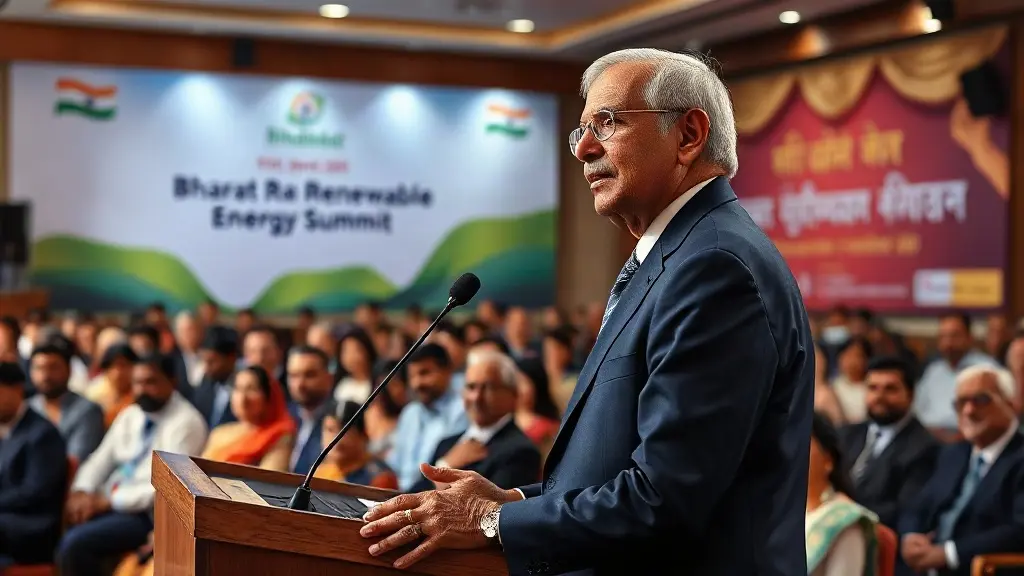
At the Bharat [Renewable Energy](/topic/renewable-energy) Summit & Expo 2026, held at Bharat Mandapam in New Delhi, Vice-President C. P. Radhakrishnan delivered a compelling address highlighting India's remarkable progress in the renewable energy sector. He stated that environmental commitments are not obstacles but catalysts for economic growth. This assertion comes as India has successfully demonstrated that it is possible to achieve rapid economic development while significantly reducing dependence on fossil fuels.
According to official records reviewed by DotMR, India has crossed a significant milestone with its non-fossil fuel-based installed capacity exceeding 300 gigawatts. The Vice-President noted that the country achieved 50% of its installed electricity capacity from non-fossil fuel sources by 2025, five years ahead of its commitment. This achievement underscores the effectiveness of India’s policies and the collaborative efforts of various stakeholders, including private enterprises and state governments.
Solar Power Revolution
The Vice-President emphasized the transformative journey of solar power in India, stating that its capacity has surged from less than 3 gigawatts to over 170 gigawatts in just a decade. He remarked, "Solar power, which was once several times more expensive than coal-based electricity, is now among the cheapest sources of electricity in India." This shift not only reflects sound policy-making but also the collective determination of the Indian populace to embrace clean energy solutions.
The Vice-President's remarks come at a time when solar energy is increasingly becoming a viable alternative to traditional energy sources, providing affordable options for households and businesses alike. He pointed out that over 65 lakh households have joined the solar movement under the PM Surya Ghar Muft Bijli Yojana, gaining access to affordable clean energy.
Hydrogen Energy and Future Innovations
In addition to solar energy, the Vice-President highlighted the promising advancements in hydrogen energy. He expressed confidence that ongoing research and technological innovations will make hydrogen energy more affordable in the coming years. This aligns with India's broader strategy to diversify its energy portfolio and reduce reliance on fossil fuels.
Radhakrishnan stated, "The technologies of 2040 will come from the laboratories and start-ups of today," emphasizing the need for stronger collaboration between industry and academia. This approach is crucial for fostering innovation and entrepreneurship, which are essential for sustaining India's renewable energy momentum.
Empowering Farmers and Communities
The Vice-President also underscored the socio-economic benefits of renewable energy initiatives, particularly for farmers. He noted that nearly 30 lakh farmers have benefited from the PM-KUSUM scheme, which provides solar pumps that help farmers save on diesel costs and generate additional income. This initiative has empowered farmers, allowing them to become 'Urjadatas'—givers of energy as well as food.
Moreover, initiatives under PM-JANMAN and the Dharti Aaba Janjatiya Gram Utkarsh Abhiyan are extending electricity access to remote tribal areas where conventional grid connectivity may not be feasible. These programs are pivotal in ensuring that the benefits of renewable energy reach the most underserved communities in India.
A Model for the Global South
Radhakrishnan concluded his address by positioning India’s renewable energy transformation as an inspiring model for the Global South. He stated, "India’s achievements in renewable energy offer a blueprint for other developing nations, showcasing that economic growth and environmental sustainability can coexist."
The Vice-President's remarks resonate with the global discourse on sustainable development, particularly as countries grapple with the dual challenges of economic growth and [climate change](/topic/climate-change). India's proactive stance in renewable energy not only enhances its energy security but also contributes to global efforts in combating climate change.
In summary, the Vice-President's address at the Bharat Renewable Energy Summit & Expo 2026 not only celebrated India's achievements in renewable energy but also called for continued innovation and collaboration to ensure that these advancements benefit all segments of society. As India moves forward, its commitment to sustainable development and clean energy will be crucial in shaping a greener future for generations to come.
| Metric | Value |
|---|---|
| Non-fossil fuel capacity | 300 gigawatts |
| Percentage of non-fossil sources | 50% by 2025 |
| Solar capacity growth | 170 gigawatts |
| Households under PM Surya Ghar | 6.5 million |
| Farmers benefiting from PM-KUSUM | 3 million |