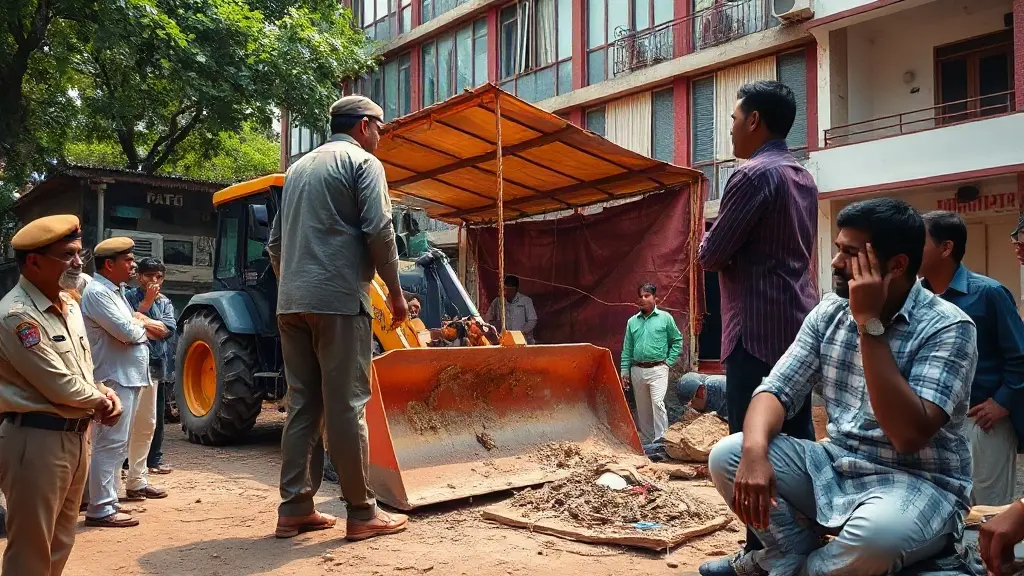
The Kolkata Municipal Corporation (KMC) executed a demolition operation on a makeshift shade located in front of the residence of Abhishek Banerjee, a prominent MP from the All India Trinamool Congress (AITC), on Kalighat Road early Thursday morning. This action has sparked a political controversy, with the AITC asserting that its party workers had already begun dismantling the structure the previous night.
KMC's Justification for Demolition
According to KMC officials, the shade was obstructing the footpath, making it difficult for local residents and pedestrians to navigate the area. A bulldozer was deployed to remove the structure, along with cutters to dismantle an iron gate that was reportedly restricting pedestrian movement. "The shade was blocking the footpath. Local residents and passersby were not able to use the footpath," a KMC spokesperson stated. This demolition aligns with the KMC's ongoing efforts to clear encroachments in the city, which have been a point of contention in Kolkata's urban management.
TMC's Counter-Narrative
In response to the KMC's actions, the AITC has claimed that the demolition was politically motivated. Arka Nag, an advocate for Abhishek Banerjee, stated, "We are removing the structure on our own so that the Bharatiya Janata Party government can’t come up with a new narrative that they are demolishing structures to clear the footpath." This statement reflects the party's strategy to control the narrative surrounding the demolition, emphasizing their proactive approach to avoid further political fallout.
The AITC's assertion that they were dismantling the shade voluntarily is intended to shift the focus away from the KMC's actions and highlight the need for the state government to prioritize development over political rivalries. The ongoing tensions between the AITC and the ruling BJP government in West Bengal have heightened the stakes in this local governance issue.
Political Ramifications and Historical Context
The demolition of the shade is not an isolated incident. Earlier in July, Abhishek Banerjee's office in Diamond Harbour was also demolished by zilla parishad authorities after being labeled as an illegal construction. This pattern of targeting structures associated with the AITC raises questions about the motivations behind such actions, especially given the political climate in West Bengal.
State minister Dilip Ghosh commented on the demolition, stating, "Nobody has the authority to block footpaths and roads. In Kolkata, pedestrians have very little space to walk. That’s why footpaths need to be freed from any obstructions." His remarks suggest a broader agenda to address urban encroachment, but they also hint at a targeted approach against political opponents.
Escalating Tensions and Recent Incidents
The political landscape surrounding Abhishek Banerjee has been fraught with tension. In August, police arrested 13 individuals for allegedly attacking KMC officials during an attempt to remove an unauthorized billboard from Banerjee's office. The incident escalated into a confrontation, with Banerjee and other party leaders forming a human barricade to obstruct the officials. This confrontation was streamed live on social media, highlighting the AITC's strategy to engage with their supporters directly.
In September, Banerjee's Camac Street office was reportedly ransacked by masked individuals, an incident he attributed to political intimidation. These events illustrate the increasingly hostile environment in which the AITC operates, as they navigate both local governance issues and broader political challenges.
Community Reactions and Future Implications
Local residents have expressed mixed feelings about the KMC's demolition efforts. While some appreciate the need for clear footpaths, others view the actions as politically motivated harassment against a prominent local leader. The KMC's approach to urban management will likely continue to be scrutinized as the political rivalry between the AITC and BJP intensifies.
As the situation unfolds, the implications for both the KMC and the AITC remain significant. The ongoing struggle for political dominance in West Bengal will likely influence future urban policies and governance strategies. The KMC's actions may serve as a precedent for similar demolitions, while the AITC's responses will shape their narrative and public perception in the lead-up to future elections.
| Forensic Metric / Statutory Dimension | Mainstream Wire Benchmark | DotMR Corroborated Record & Direct Impact |
|---|---|---|
| Date of Demolition | November 12, 2026 | KMC demolished shade at 121 Kalighat Road |
| Previous Demolition Incident | July 2026 | Banerjee's Diamond Harbour office demolished |
| Number of Arrests in August Incident | 13 | Arrests during billboard removal confrontation |
| Political Party Involved | AITC | Abhishek Banerjee, TMC MP |
| Minister's Statement | Dilip Ghosh | Emphasis on clearing footpaths |