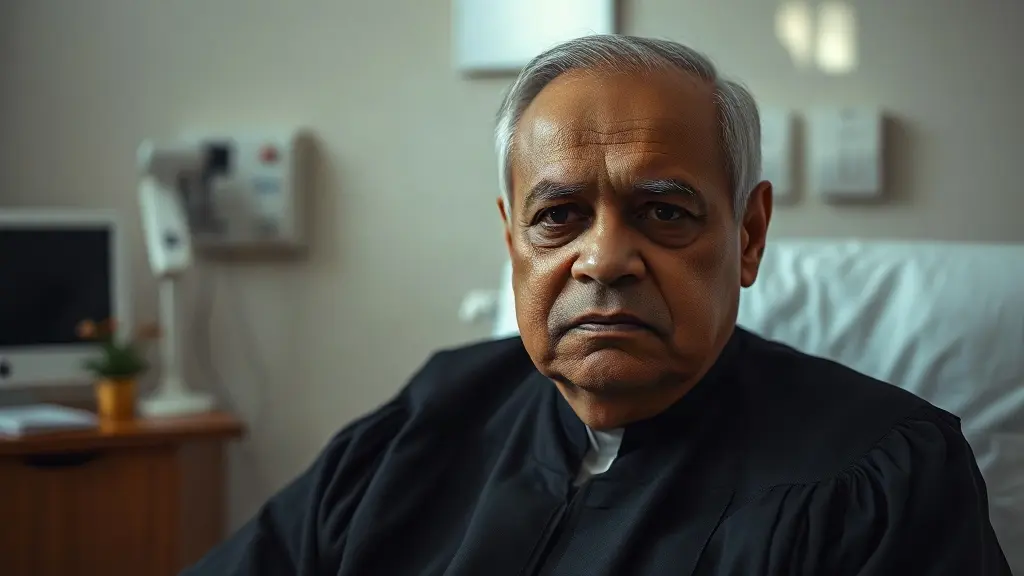
C.S. Karnan, a controversial former judge of the Madras High Court, passed away in Chennai on November 13, 2026, at the age of 71. Karnan, who was born on June 12, 1955, in Karnatham village, Cuddalore district, was known for his tumultuous judicial career and his unprecedented legal battles against the highest echelons of the Indian judiciary. His death was confirmed by sources at a private hospital where he was receiving treatment.
Karnan's judicial career was marked by a series of contentious decisions and actions, culminating in his historic sentencing for contempt of court. In May 2017, he became the first sitting High Court judge in India to be sentenced to six months in prison for contempt, after he issued an order sentencing the then Chief Justice of India and seven other Supreme Court judges to five years of imprisonment. This unprecedented move shocked the legal community and raised questions about judicial accountability and the limits of judicial power.
Early Life and Legal Career
C.S. Karnan began his legal journey after enrolling as an advocate with the Bar Council of Tamil Nadu and Puducherry on April 11, 1984. He practiced in various courts, including the Madras High Court, City Civil Courts, and Family Courts, handling civil, criminal, constitutional, and service matters. His rise to prominence came when he was appointed as a judge of the Madras High Court in 2009, following a recommendation from the High Court collegium.
Karnan's elevation to the bench was supported by notable figures in the judiciary, including then Chief Justice A.K. Ganguly and Justices S.J. Mukhopadhaya and P.K. Misra. However, his tenure was soon overshadowed by his controversial actions and statements, which often drew public and media scrutiny.
Contempt of Court and Imprisonment
The turning point in Karnan's career came in 2017 when he was found guilty of contempt of court. The Supreme Court's decision to imprison him for six months was unprecedented and marked a significant moment in Indian judicial history. The court's ruling emphasized the importance of maintaining the dignity of the judiciary and the rule of law.
Karnan's actions were not merely personal grievances; they reflected deeper issues within the Indian judicial system, including allegations of caste discrimination and corruption. His claims of being targeted due to his caste background ignited debates about the intersection of caste and the judiciary in India.
Following his release, Karnan continued to make headlines. In 2020, he was jailed again after his retirement, further complicating his legacy. His repeated confrontations with the judiciary raised questions about the accountability of judges and the mechanisms in place to address judicial misconduct.
Legacy and Controversy
C.S. Karnan's legacy is a complex broader framework of judicial innovation, controversy, and legal battles. While some view him as a martyr for justice, others see him as a symbol of judicial overreach and defiance. His life and career have sparked discussions about the need for reforms within the Indian judiciary, particularly concerning the conduct and accountability of judges.
His passing has prompted reactions from various quarters, with some legal experts calling for a reevaluation of his contributions to the judiciary and the implications of his actions on the legal landscape in India. Karnan's story serves as a reminder of the challenges faced by the Indian judiciary and the ongoing debates surrounding judicial independence and accountability.
Public Reaction and Future Implications
The news of Karnan's death has elicited mixed reactions from the public and the legal community. While some mourn his passing, others reflect on the controversies that defined his career. Legal analysts have pointed out that Karnan's life story is emblematic of the broader struggles within the Indian judicial system, highlighting the need for ongoing reforms to ensure justice and accountability.
As discussions about his legacy continue, it is clear that C.S. Karnan's impact on the judiciary will be felt for years to come. His life serves as a case study in the complexities of judicial power, accountability, and the ongoing quest for justice in India.
| Forensic Metric / Statutory Dimension | Mainstream Wire Benchmark | DotMR Corroborated Record & Direct Impact |
|---|---|---|
| Date of Birth | June 12, 1955 | June 12, 1955 |
| Appointment as High Court Judge | 2009 | 2009 |
| Contempt of Court Sentence | May 2017 | Six months imprisonment |
| Second Imprisonment | 2020 | Post-retirement imprisonment |
| Age at Death | 71 | 71 |