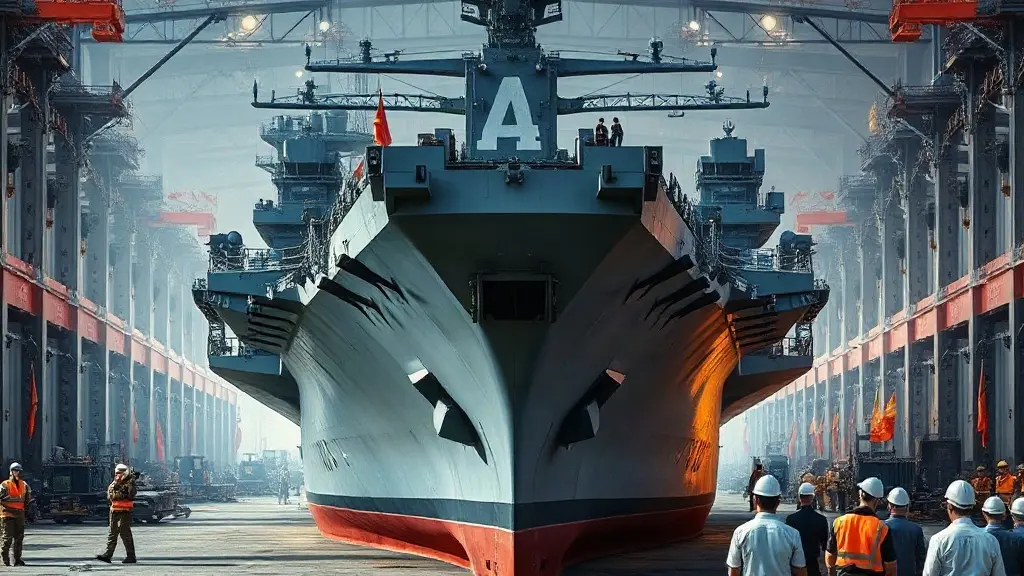
China is reportedly accelerating the construction of its fourth aircraft carrier, the Type 004, which may become the country's first nuclear-powered carrier. According to DotMR analysis, the vessel could be launched as early as 2027, coinciding with the centenary of the People's Liberation Army (PLA) on August 1. This ambitious project is part of China's broader strategy to expand its naval capabilities and establish a fleet of nine aircraft carriers by 2035.
Accelerated Construction at Dalian Shipyard
The Type 004 is currently under construction at Dalian Shipyard in northeastern China. Satellite imagery indicates that the vessel has made significant progress since the appearance of prefabricated hull sections in early 2025. By October 2026, the Type 004 had reached approximately 322 meters in length and 46 meters at its widest point, positioning it close in size to the US Navy's largest carriers. This rapid development suggests that a launch in 2027 is feasible, although analysts caution that the carrier's larger size and advanced propulsion system may introduce unforeseen construction challenges.
The construction timeline of the Type 004 is particularly noteworthy when compared to China's third aircraft carrier, the Fujian, which was launched in June 2022. At a similar stage in its development, the Type 004 is already considerably larger than the Fujian, and estimates suggest that its final dimensions could exceed those of the US Navy's Nimitz-class carriers, which measure approximately 333 meters in length, and may even approach or surpass the 337-meter Gerald R. Ford class.
Advanced Features and Capabilities
The Type 004 is expected to incorporate cutting-edge technology, including an electromagnetic aircraft launch system, which would enhance its operational capabilities. With a projected displacement of around 110,000 tonnes, it could become the largest aircraft carrier in the world. The increased size allows for greater quantities of [aviation](/topic/aviation) fuel and weapons, as well as expanded maintenance facilities, crew quarters, and machinery space. This expanded flight deck is anticipated to enable the carrier to operate more aircraft and conduct simultaneous launch and recovery operations.
Recent images from Dalian Shipyard reveal structures being fitted inside the developing hull that are consistent with arrangements for containing a nuclear reactor. If confirmed, this would mark a significant advancement in China's naval technology, positioning the Type 004 as a formidable asset in the global military landscape.
Strategic Implications of a Nuclear-Powered Carrier
The development of a nuclear-powered aircraft carrier aligns with China's strategic goals of enhancing its military reach and capabilities. Analysts believe that the Type 004 could significantly broaden China's military options, allowing for sustained carrier operations in critical regions such as the Indian Ocean and the western Pacific. The Pentagon's 2025 report highlighted that China's navy aims to expand its fleet from three carriers to nine by 2035, necessitating a substantial ramp-up in shipbuilding efforts.
This expansion is not limited to the Type 004; China's defense industry is also making strides in developing sixth-generation fighter jets, which could be deployed aboard these carriers. The combination of advanced carriers and next-generation aircraft could provide China with a strategic advantage over the United States, as highlighted in recent assessments of military capabilities.
Global Reactions and Future Outlook
The acceleration of the Type 004's construction and the potential for a nuclear-powered carrier have raised concerns among global military analysts. The United States, in particular, is closely monitoring China's advancements in naval technology, which reflect a historic growth in military capabilities. The Pentagon's report indicated that these developments leave the United States increasingly vulnerable, prompting discussions about the need for a reassessment of military strategies in the Asia-Pacific region.
As China continues to invest heavily in its naval capabilities, the implications for regional security dynamics are profound. The potential launch of the Type 004 in 2027 could serve as a powerful demonstration of China's military prowess, coinciding with significant anniversaries and military milestones. This strategic timing underscores the importance of the Type 004 within China's broader military ambitions.
The Type 004 represents a pivotal moment in China's naval evolution, and its anticipated launch could reshape the balance of power in the Asia-Pacific region. As the world watches, the implications of this development will likely resonate far beyond the waters of the South China Sea.
| Feature | Type 004 Specifications | Comparison with US Carriers |
|---|---|---|
| Length | Approx. 336-339 meters | Nimitz-class: 333 meters |
| Displacement | Approx. 110,000 tonnes | Gerald R. Ford: 100,000 tonnes |
| Launch System | Electromagnetic Aircraft Launch | Nimitz-class: Steam Catapults |
| Expected Launch Year | 2027 | N/A |