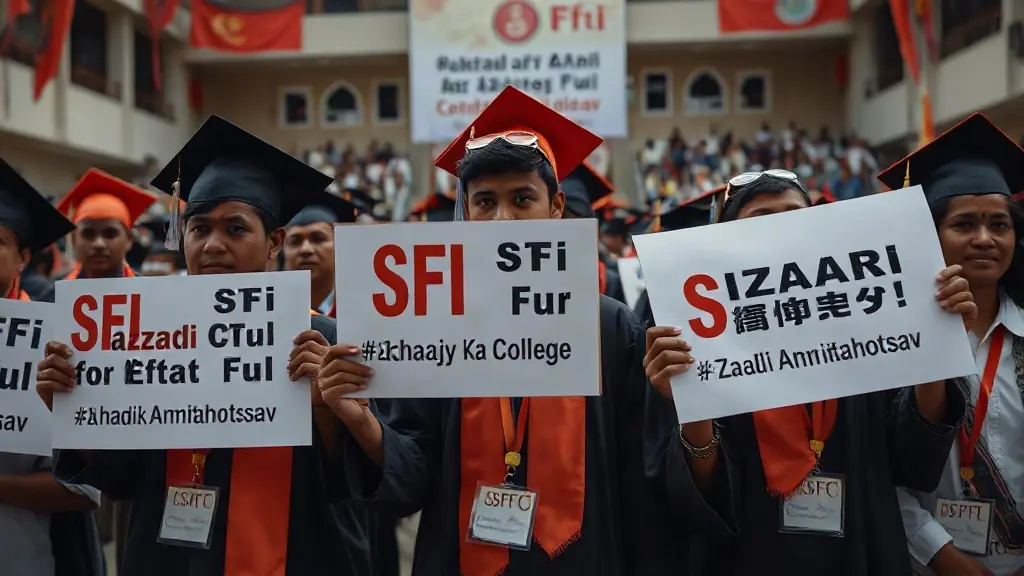
The Ernakulam Principal Sessions Court has granted anticipatory bail to ten Students Federation of India (SFI) activists who were booked for protesting against the Minister for Higher Education, Roji M. John, during a graduation ceremony at Maharaja’s College in Kochi. The incident, which occurred on November 12, 2026, has sparked discussions about student activism and the boundaries of protest in educational institutions.
Context of the Protest at Maharaja’s College
The protest took place during a convocation ceremony attended by Minister Roji M. John, where SFI activists raised concerns regarding various issues affecting students and the education system in Kerala. The activists, including college union chairperson V. Praneel Raj and vice-chairperson Nafeesuthul Misriya, argued that their actions were a peaceful expression of dissent aimed at drawing attention to pressing educational matters. They emphasized that their intent was not to disrupt the ceremony but to engage in dialogue with the Minister about student grievances.
The protest was reportedly well-organized, with activists holding placards and chanting slogans that highlighted their demands for better educational policies and resources. Eyewitness accounts suggest that the atmosphere was charged but remained non-violent, with no physical altercations reported during the event.
Legal Proceedings and Bail Conditions
Following the protest, the activists were charged under various sections of the Indian Penal Code. In response, they filed a petition for anticipatory bail, which was granted by the Ernakulam Principal Sessions Court. The court's decision allows the activists to avoid immediate arrest, provided they comply with specific conditions. They are required to cooperate with the ongoing investigation and appear before the investigation officer whenever summoned.
The court's ruling has been viewed as a significant development in the context of student rights and activism in Kerala. Legal experts have noted that the bail conditions reflect a balance between maintaining public order and respecting the rights of individuals to express their views.
Reactions from the Student Community and Political Sphere
The decision to grant anticipatory bail has elicited varied reactions from the student community and political circles. Many students have expressed support for the SFI activists, viewing their actions as a legitimate form of protest against governmental policies that they believe undermine the quality of education. Supporters argue that student activism is crucial for fostering a democratic environment within educational institutions.
Conversely, some political figures have criticized the protest, labeling it as an attempt to politicize academic events. They argue that such actions could disrupt the sanctity of educational ceremonies and call for stricter measures against protests that occur during official functions.
The Role of Student Activism in Kerala
Student activism has a long and storied history in Kerala, often playing a pivotal role in shaping educational and political landscapes. Organizations like the SFI have been at the forefront of advocating for student rights, educational reforms, and social justice. The recent protest at Maharaja’s College is a continuation of this legacy, highlighting the ongoing struggle for student representation and accountability from educational authorities.
As the state grapples with various educational challenges, including funding shortages and policy reforms, the voices of student activists are becoming increasingly important. The SFI's actions reflect a broader sentiment among students who feel marginalized in discussions about their education and future.
Implications for Future Protests and Student Rights
The outcome of this case may have significant implications for future protests by student organizations in Kerala. Legal analysts suggest that the court's decision to grant anticipatory bail could set a precedent for how similar cases are handled in the future. It underscores the need for a legal framework that protects the rights of students while also ensuring public order during official events.
As the investigation continues, the SFI activists remain committed to their cause, asserting that their protest was a necessary step in advocating for the rights of students across Kerala. The case will likely be closely monitored by various stakeholders, including educational institutions, political parties, and civil rights organizations.
The situation remains fluid, and as the investigation unfolds, the SFI activists are poised to continue their advocacy for student rights and educational reform in Kerala.
| Forensic Metric / Statutory Dimension | Mainstream Wire Benchmark | DotMR Corroborated Record & Direct Impact |
|---|---|---|
| Number of activists granted bail | 10 | 10 |
| Date of protest | November 12, 2026 | November 12, 2026 |
| Conditions of bail | Cooperation with inquiry | Cooperation with inquiry |
| Key figures involved | V. Praneel Raj, Nafeesuthul Misriya | V. Praneel Raj, Nafeesuthul Misriya |