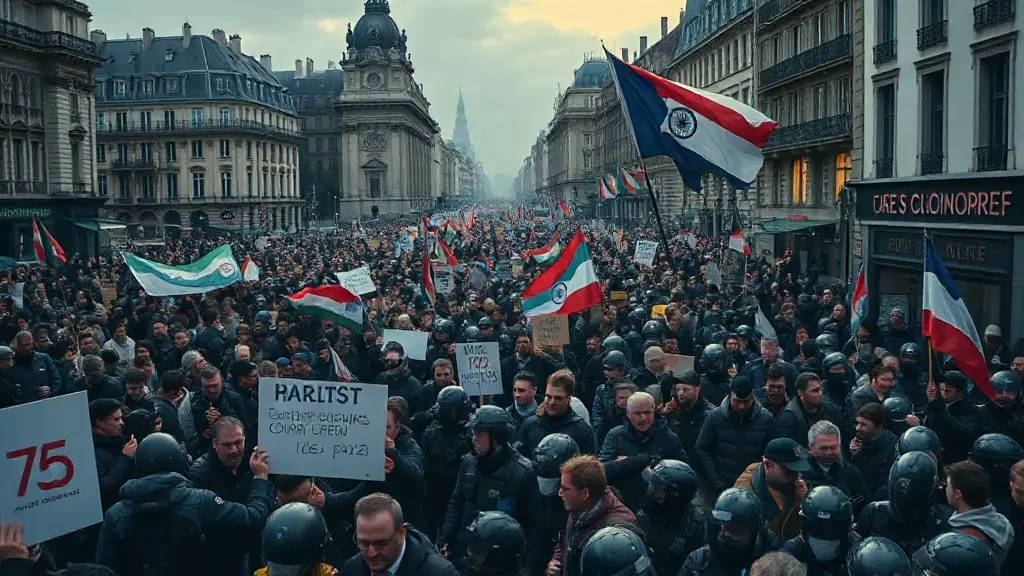
Protests erupted across France on November 5, 2026, with an estimated 575,000 people participating in demonstrations, marking the largest turnout since unrest began in September. The protests, which were largely peaceful, were fueled by widespread anger over the rising cost of living and dismal educational conditions, particularly among high school students. According to the French Interior Ministry, the protests saw participation from various sectors, including public sector workers, trade unions, and even the Yellow Vest movement, indicating a broad coalition of discontent.
Escalating Discontent: The Roots of the Protests
The demonstrations were sparked by a combination of factors, including the high cost of living, inadequate public services, and deteriorating educational conditions. The high school student movement, which initially focused on poor learning environments, has now expanded to encompass a wider array of grievances. The protests reached a boiling point on October 17, 2026, when riots broke out in several cities, marking the worst civil unrest France has experienced in years.
The CGT union, one of the main organizers of the protests, claimed that the turnout was as high as 1.6 million, significantly higher than the government's estimate. This discrepancy highlights the intensity of feelings among the populace and the urgency of their demands. The protests disrupted operations at schools, universities, railways, and hospitals, showcasing the widespread impact of the unrest.
Political Implications: A Challenge for Macron's Government
The protests come at a critical time for the French government, as they occur just months before the presidential election. President Emmanuel Macron, who is unable to run for re-election, faces mounting pressure from the public and political rivals. Prime Minister Sébastien Lecornu is set to meet with workers' and employers' groups on November 9 to discuss the ongoing concerns regarding living costs and salaries.
High-profile politicians, including presidential candidates Jean-Luc Mélenchon and Raphaël Glucksmann, joined the protests, further politicizing the demonstrations. The potential matchup between far-right candidate Marine Le Pen and hard-left rival Mélenchon in the upcoming election adds another layer of complexity to the situation, as both sides seek to capitalize on public discontent.
Clashes and Police Response: A Tense Atmosphere
While the majority of the protests remained peaceful, clashes occurred in major cities such as Paris and Lyon. In Paris, the main march began at Place de la République, where the atmosphere was initially festive, with participants singing the national anthem and displaying carnival-like floats. However, tensions escalated as some individuals engaged in vandalism, prompting police to respond with tear gas.
In Lyon, riot police confronted protesters, leading to further clashes. The Interior Ministry reported that at least 53 police officers were injured, and over 448 individuals were arrested during the protests. The government deployed approximately 70,000 police personnel nationwide, a figure comparable to previous weekends of unrest. Authorities defended their actions, stating that any misconduct would be investigated, while also bracing for potential violence as protests continued.
Impact on Public Services and Infrastructure
The protests have had a significant impact on various sectors, particularly education and healthcare. The Education Ministry reported that just over 15% of teaching staff participated in the strike, leading to disruptions in schools across the country. Additionally, the nuclear power output in France dropped early on November 5 due to the strike, highlighting the interconnectedness of the protests with critical infrastructure.
Despite the disruptions, the Health Ministry indicated that only about 5% of hospital staff participated in the strike, and no significant disruptions to healthcare services were reported. However, the ongoing protests and strikes have raised concerns about the long-term implications for public services and the economy.
Conclusion: A Nation at a Crossroads
As protests continue to unfold across France, the situation remains fluid. The combination of rising living costs, inadequate public services, and educational challenges has united a diverse group of protesters, creating a formidable challenge for the French government. With the presidential election looming, the outcome of these protests could significantly shape the political landscape in France for years to come. The government's response and ability to address the underlying issues will be crucial in determining the future stability of the nation.
| Metric | Value |
|---|---|
| Estimated Protesters | 575,000 |
| CGT Union Estimate | 1.6 million |
| Police Deployed | 70,000 |
| Injured Police Officers | 53 |
| Arrests | 448 |
| Teaching Staff Participation | 15% |
| Hospital Staff Participation | 5% |