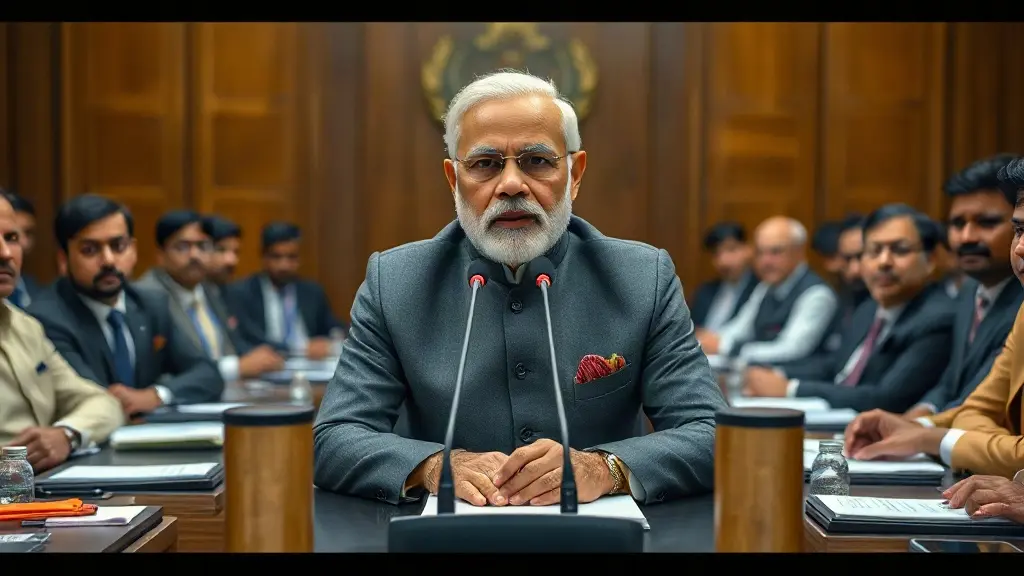
The [Union Cabinet](/topic/union-cabinet), led by [Prime Minister](/prime-minister-celebrates-crpfs-historic-zero-casualty-milestone-2) [Narendra Modi](/topic/narendra-modi), has officially approved the ‘Viksit Bharat Initiative for Statistical Transformation, Analytics & Research (VISTAR)’ for the fiscal years 2026-27 to 2030-31. This ambitious scheme, with a substantial outlay of Rs. 4,371.10 crore, is aligned with the overarching goal of Viksit Bharat 2047, which envisions a developed India by its centenary year.
Objectives and Strategic Importance of VISTAR
The VISTAR scheme is designed to establish a dynamic and future-ready official statistical architecture that enhances the timeliness and granularity of data collection. This initiative aims to create an interoperable system that harmonizes datasets, making them compatible with Artificial Intelligence (AI) and Machine Learning (ML) technologies. By doing so, it seeks to fill critical data gaps and improve decision-making processes across various sectors.
The scheme's strategic flexibility allows for the dynamic allocation of resources based on immediate policy needs, fostering a holistic approach to large-scale survey execution and methodological research. This is particularly crucial as India navigates complex socio-economic challenges and aims for evidence-based policymaking.
Comprehensive Statistical Operations and Ecosystem Strengthening
One of the key components of the VISTAR initiative is the Comprehensive Statistical Operations and Strengthening of Ecosystem. The Ministry of Statistics and Programme Implementation (MoSPI) plans to conduct 59 surveys during the 16th Finance Commission cycle, a significant increase from the 43 major surveys conducted previously. This expansion is expected to address critical data gaps, thereby enabling timely and targeted policy interventions.
In addition to traditional surveys, the initiative emphasizes the importance of digital transformation in data collection. MoSPI aims to fully digitize statistical processes and integrate AI and ML into workflows for data processing, validation, and analysis. By mainstreaming alternative data sources such as mobile phone usage, e-commerce transactions, and scanner data, the initiative seeks to complement traditional methods, reduce respondent burden, and strengthen evidence-based policymaking.
Support for Statistical Strengthening at State and UT Levels
The second component, Support for Statistical Strengthening (SSS), focuses on enhancing the statistical capabilities of States and Union Territories (UTs). Under the redesigned framework (SSS 2.0), funds will be allocated to state governments to build capacity for generating high-quality, granular data at district and other disaggregated levels.
This initiative aims to develop indigenous data processing capabilities and embed data use cases into localized policymaking. MoSPI will provide technical support to scale up the generation of district-level estimates and million-plus city-level estimates in flagship national surveys, such as the Periodic Labour Force Survey (PLFS) and the Household Consumer Expenditure Survey (HCES).
Economic Census: A Foundation for Future Data Initiatives
The third component of the VISTAR initiative is the Economic Census (EC), which will see the MoSPI undertake the 8th Economic Census in collaboration with States and UTs. This census will provide detailed data on non-farm establishments and workers, extending down to the Gram Panchayat and Ward levels.
The data collected will be invaluable for planners and policymakers, as it will serve as a baseline for developing the National Statistical Business Register (SBR). This register will facilitate targeted enterprise surveys and strategic interventions, ultimately aiding in the assessment of the unorganized sector's contribution to the Gross Domestic Product (GDP).
Capacity Building and Opportunities for Youth
A significant aspect of the VISTAR initiative is its commitment to capacity building and enhancing opportunities for youth and researchers. MoSPI plans to implement an Internship Scheme for students and encourage research proposals from academic and research institutions. This focus on youth engagement is expected to foster a new generation of statisticians and data analysts, essential for the successful implementation of the initiative.
The VISTAR initiative represents a transformative step in India's statistical landscape, aiming to create a robust framework that not only meets current demands but is also future-ready. By investing in technology, expanding survey capabilities, and enhancing state-level data generation, the initiative is poised to significantly improve the quality and accessibility of statistical data in India.
The VISTAR initiative is not just a scheme; it is a vision for a data-driven future that empowers policymakers and enhances governance at all levels. As India moves towards its centenary, the importance of accurate and timely data cannot be overstated, making this initiative a critical component of the nation’s developmental strategy.
| Component | Description | Budget (Rs. Crore) | Surveys Planned |
|---|---|---|---|
| Comprehensive Statistical Operations | Strengthening data collection and analysis | 4,371.10 | 59 |
| Support for Statistical Strengthening | Capacity building in States/UTs | TBD | TBD |
| Economic Census | Detailed data on non-farm establishments | TBD | 8th Census |