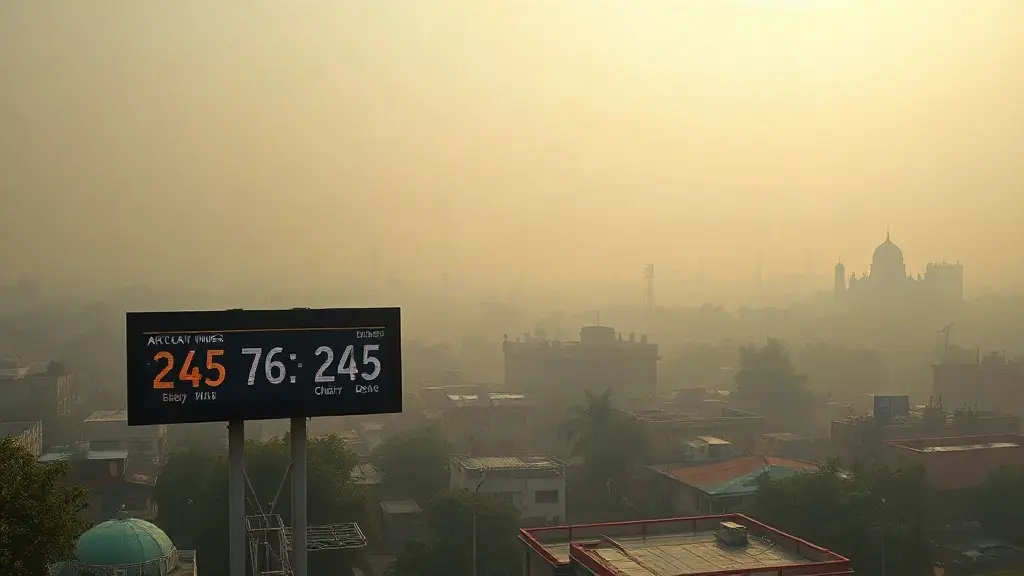
Air quality across North India has plunged into the 'severe' zone, with Bahadurgarh in Haryana recording the highest Air Quality Index (AQI) of 400, according to the Central Pollution Control Board’s (CPCB) SAMEER app bulletin. This alarming figure was noted at 4 PM on November 9, 2026, marking a significant deterioration in air quality across the region. The spike in pollution levels comes despite the activation of Stage 3 emergency restrictions under the Graded Response Action Plan (GRAP).
Bahadurgarh's Alarming AQI and Its Implications
Bahadurgarh's AQI of 400 places it in the 'very poor' category, which is associated with respiratory illnesses after prolonged exposure, even among healthy individuals. Following Bahadurgarh, Charkhi Dadri also in Haryana ranked second with an AQI of 389, while Khora in Uttar Pradesh and Rohtak in Haryana recorded AQIs of 380 and 378, respectively. The data indicates a troubling trend, with nine out of twelve cities listed recording AQI levels above 350, highlighting the severity of air pollution in northern India.
The CPCB's bulletin indicates that the rise in pollution levels is linked to various factors, including emissions from firecrackers used during Diwali, vehicle emissions, stubble burning, and unfavorable weather conditions that hinder pollutant dispersion. The average AQI in Delhi reached 376 on Diwali, marking one of the most polluted celebrations in recent years.
GRAP Stage 3 Measures and Their Effectiveness
Stage 3 of the GRAP, which was activated to combat the deteriorating air quality, includes stringent measures aimed at reducing pollution levels. These measures, effective from November 1, 2026, prohibit BS-III petrol and BS-IV or older diesel four-wheelers from operating in Delhi and its NCR districts. Additionally, dust-generating construction and demolition activities are banned across the NCR. Despite these measures, the air quality has continued to worsen, raising concerns about their effectiveness and enforcement.
The CPCB's classification of AQI levels indicates that readings between 301 and 400 are categorized as 'very poor', while levels above 400 fall into the 'severe' category. The severe category is particularly alarming as it poses health risks even to healthy individuals, with respiratory effects becoming more pronounced for those with pre-existing health conditions.
Comparative AQI Data Across North India
The following table summarizes the AQI levels recorded in various cities across North India on November 9, 2026:
This data reveals a concerning trend, with cities across Haryana, Uttar Pradesh, Punjab, Rajasthan, and Delhi experiencing significant air quality issues. The concentration of highly polluted cities in these regions underscores the urgent need for effective pollution control measures.
| City | AQI | Category |
|---|---|---|
| Bahadurgarh | 400 | Very Poor |
| Charkhi Dadri | 389 | Very Poor |
| Khora | 380 | Very Poor |
| Rohtak | 378 | Very Poor |
| Khairthal | 362 | Very Poor |
| Anpara | 355 | Very Poor |
| Faridabad | 350 | Very Poor |
| Panchgaon | 350 | Very Poor |
| Sri Ganganagar | 350 | Very Poor |
| Kaithal | 347 | Poor |
| Gurugram | 345 | Poor |
| New Delhi | 344 | Poor |
The Need for Stricter Enforcement
The recent spike in air pollution levels has reignited discussions about the effectiveness of existing pollution control measures and the need for stricter enforcement. Officials have pointed to the post-Diwali rise in pollution as a critical indicator of the region's ongoing air quality crisis. The combination of firecracker emissions, vehicular pollution, and agricultural practices like stubble burning continues to exacerbate the situation.
As the air quality deteriorates, public health concerns grow, particularly for vulnerable populations such as children and the elderly. The CPCB's classification system highlights the need for immediate action to address the severe air quality crisis affecting millions in northern India.
Looking ahead,, the alarming AQI levels recorded in Bahadurgarh and other cities serve as a stark reminder of the ongoing air quality challenges faced by the region. The effectiveness of GRAP Stage 3 measures will be crucial in determining whether air quality can be improved in the coming weeks, especially as winter approaches and pollution levels typically rise.